
NETPAC Jury
Nada Azhari Gillon (Chairperson) (Syria/France) NETPAC Member
Sergei Anashkin (Russian Federation) NETPAC Member
Mansur Giliazov (Republic of Tatarstan- Russian Federation) appointed by the festival
XXI Kazan International Film Festival “Altyn Minbar” films were in the NETPAC Competition
- K-Popper (Iran, 2025, IP, debut) – Main Competition
- The Puppet’s Tale (India, 2024, RP) – Main Competition
- Onegin Hotel (Russia, 2025) – Main Competition
- The Song Sustxotin (Uzbekistan, 2024, RP, 2nd film) – Main Competition
- Pavane for an Infant (Malaysia – China (Hong Kong), 2024, RP) – Main Competition
- Salma (Syria, 2024, RP) – Main Competition
- The Black Forest (Russia-Germany, 2024) – Main Competition
- Evacuation (Kazakhstan, 2025) – Main Competition
- Mothers and Children (Russia, Tatarstan, 2025) – National Competition
- Adventures (Russia, Tatarstan, 2025) – National Competition
- May, 1944 (Russia, Tatarstan, 2025) – Russia – Islamic World, Opening Film
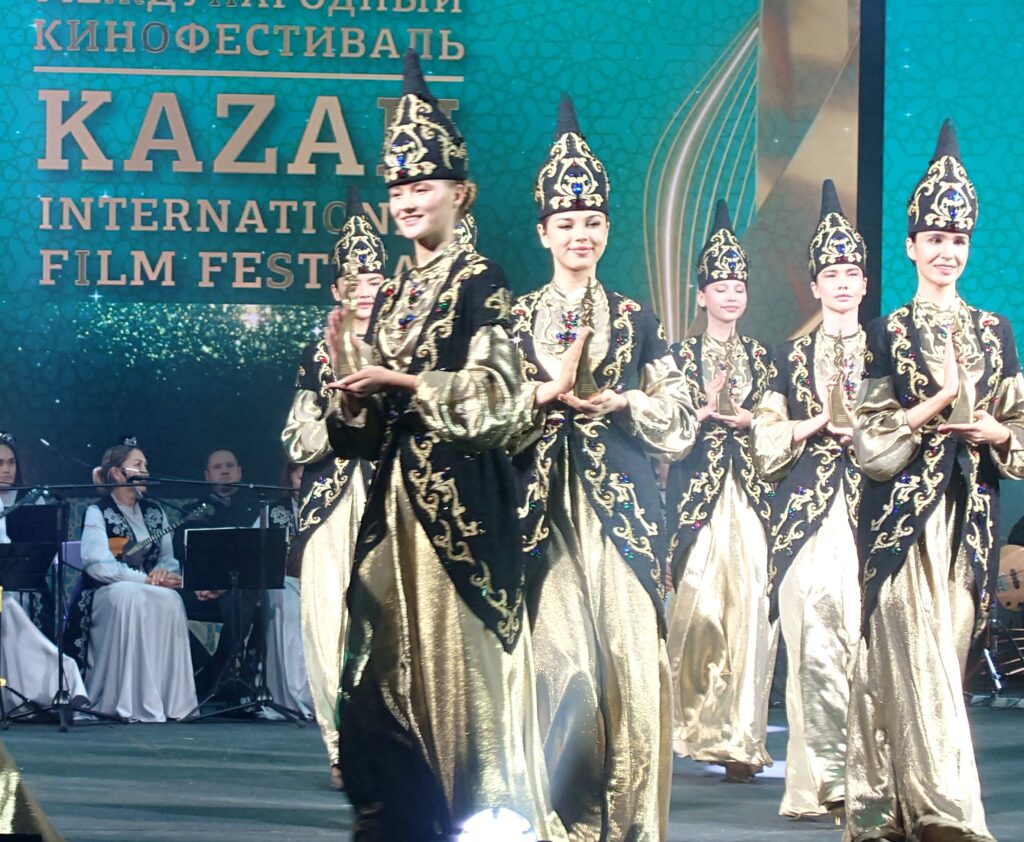
After reading the introductions of founders, partners and organizers of the festival in the catalogue, hearing the opening speeches about the festival’s identity, its spiritual role, and the values it emphasizes, one becomes curious about the films being screened and whether they have any differences with other festivals. One immediately notices the similarity of the films to those shown in Iranian festivals, for example, where there is no violence, sex, nudity, or discrimination based on religious or national characteristics.
The festival was organized in 2005 under the initiative of the Muftis Council of Russia, The Federal Agency of Culture and cinematography of Russian Federation, and the Ministry of Culture of the Republic of Tatarstan with the support of the Rais of the Tatarstan. The theme of the current session (September 5-9, 2025) of Kazan International Film Festival, like every other session, was “Through the dialogue of Cultures to a Culture of dialogue.” The list of selected films included feature films, short films, animation and documentaries from Asia, Europe, America, Australia, the Commonwealth of Independent States, and from all parts of the Arab world.
The focus on social themes can be noticed without implying repetition. Diversity was evident in each of the eleven feature films participating in the main official competition, and audiences were introduced to a wide range of films representing different societies. The issue of conflict between authenticity and modernity was in an epic film from India, “The Doll’s Tale,” by Suman Mukhopadhyay which exploring, with a magnificent visual language, through the eyes of an idealistic doctor who is forced to seek ways to overcome the stereotypes of traditional culture. While “K-Popper” (2025) by Ebrahim Amini, winner of Best Director Award and NETPAC Award, brilliantly raises questions about issues revolving around personal freedom and choices, especially for teenagers, when they do not conform to convention in modern Iran. Questions of Identity, alienation, and the impossibility of escaping the past came in a “CARVED BY THE WIND” by Laila Triqui from Morocco. The female theme and Issues of traditional societies were explored in three films:
“The Song Sustxotin” by Husnora Rozmatova from Uzbekistan who treats the association with ancient rituals related to female sacrifice to the gods during drought, for example. “Salma” by the Syrian Joud Said about the suffer of a woman in a civil war, and “Pavane for an Infant” by Chong Keat Aun from Malaysia where Serious questions are being raised about the situation of women who find themselves in difficult circumstances after unwanted pregnancies in conservative Malaysia.
A different film came from Russia, “ONEGIN Hotel” (2025) by Irina Margolina is an artistic interpretation of Pushkin’s novel “Eugene Onegin”.
Three films dealing with World War II were screened in the competition. “Evacuation” (2024), a black-and-white film by Kazakh director Farkhat Sharipov, won the Best Screenplay Award. Based on the memoirs of Leningraders evacuated during the war, it explores issues of migration, memories, and tragedies with the story of ordinary people facing the horrors of war. “Black Forest” (Russia/Germany), by Radik Kudoyarov, is dedicated to the great Tatar poet Musa Jalil. Inspired by true events, a German commander faces a difficult task. To accomplish it, he needs a poet sentenced to death in a Berlin prison. The third film, “Tower of Power” (2025), from Montenegro, won the Grand Prize for Best Film. A young director Nikola Vukcevic explores the limits of the human spirit through Albanian history. Set during World War II in Yugoslavia, it tells the story of an orphaned Christian boy whose parents were killed and his village burned by a fascist military unit. He finds refuge in a Muslim home.
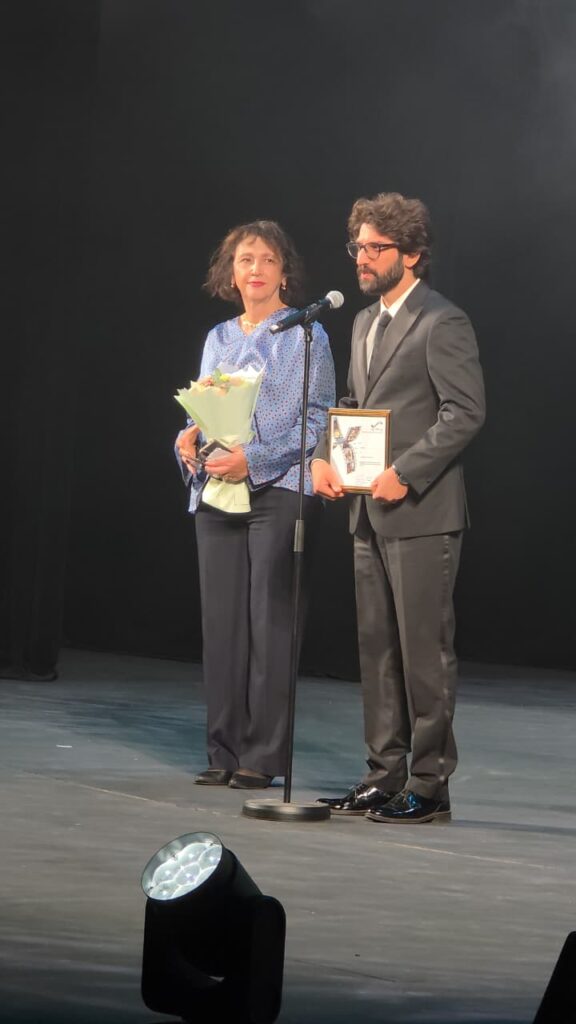
NETPAC also gave special mention to “In May 1944” by director Alexander Dalmatov (Republic of Tatarstan) from the National Competition section.
The award for Best Short Narrative Film went to “Stateless.” By Iranian Seyed Mohamadhosein Hoseini. This film depicts the tragedy of an Afghan father struggling with the dilemma of illegal residency in Iran. It is a poignant, humane narrative that reveals the harshness of reality and confronts the viewer with questions of fate, identity, and justice.
The award for Best Documentary went to “The Lost Season”, by the Iranian Mehdi Ghanavati which presented a powerful portrait of the lives of the residents of an Iranian village, ravaged by drought and humiliated by dust storms. The film portrays the suffering of people as a mirror of a harsh time that ravages the details of daily life, where the struggle for survival blends with nostalgia for a more compassionate past.
The festival was enjoyable, with a wonderful warmth welcome and attentiveness to the guests. However, due to its short duration, the guests had to start watching the films before arriving, which made the chances of meeting the Tatar audience in the cinemas less. This is unfortunate.
Nada Azhari Gillon
A Syrian French critic living in France and having lived in several Arab countries, Iran and India. She is mainly interested in Asian, Arab and French cinema. She regularly collaborates with Arab newspapers such as Al-Hayat (2000-2018), Al-Araby Al-Jadeed (since 2018), and websites such as Al Jazeera Documentary (since 2011) and Diffah.
Author of two books:
Contemporary Iranian Cinema (2012)
An Arab Woman in Iran (2024)
She is a member of NETPAC, FIPRESCI and the Federation of Film Journalists in France.
She covers film festivals and has been a jury member at several festivals in India, Kazakhstan, Iraq, Turkey, Egypt, France, Korea, Morocco, Locarno and Karlovy Vary.